
Description
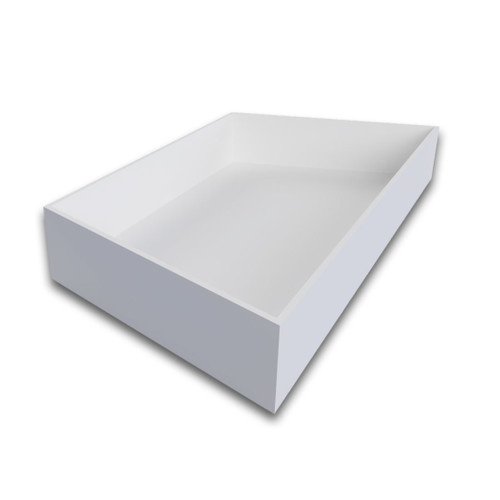
Secondary spill trays for safety, compliance and additional protection in your chemical storage areas. Catch drips, prevent spills and corrosion, and keep certain chemicals segregated by using a tray sysem. Polyethylene spill trays provide long lasting containment without the risk of corrosion or breakage. One-piece rotationally molded design offers drip compliance and protects cabinetry. Available in over standard 250 sizes to fit lab benches, counters, shelves, drawers and cabinets. Custom sizes and shapes available upon request. These trays come with a raised edge in 1″, 1.5″ or 2″ high.
100% polyethylene construction
Acid resistant / highly chemical resistant resin
One-piece design
Choose from 1″, 1.5″ or 2″ high edges
Thick 3/16″ walls are made of an impact-resistant plastic that resists breakage
Interior corners are coved for easy cleaning
Dishwasher safe
Natural white color
Made in the USA
Complies with the following regulations (when sized correctly):
Occupational Safety and Health Administration, OSHA 1910.1450
(b) Stockrooms/storerooms … Chemicals which are highly toxic … should be in unbreakable secondary containers…..A spill control policy should be developed and should include consideration of prevention, containment, cleanup and reporting.
Environmental Protection Agency, EPA 264.175:
(a) Container storage area must have a containment system that is designed and operated in accordance with paragraph (b).
(b) A containment system must be designed and operated as follows: (1) a base must underlie the containers which is free of cracks or gaps and is sufficiently impervious to contain leaks, spills.
(3) The containment system must have sufficient capacity to contain 10% of the volume of containers or the volume of the largest container whichever is greater.
1910.1450 Appendix A – National Research Council Recommendations Concerning Chemical Hygiene in Laboratories
5. Institute a Chemical Hygiene Program –A comprehensive chemical hygiene program is required. It should be designed to minimize exposures, injuries, illnesses and incidents. There should be a regular, continuing effort that includes program oversight, safe facilities, chemical hygiene planning, training, emergency preparedness and chemical security. The chemical hygiene program must be reviewed annually. and updated as necessary whenever new processes, chemicals, or equipment is implemented. Its recommendations should be followed in all laboratories.
Popular Standard SKU Sizes with 2″ H Walls (also available in 1″ and 1.5″ high)
SKU
Length
inches
Width
inches
Height
inches
SCIP-T520909-201
9
9
2
SCIP-T5212.512.5-201
12.5
12.5
2
SCIP-T521411-201
14
11
2
SCIP-T521608-201
16
8
2
SCIP-T521818-201
18
18
2
SCIP-T522010-201
20
10
2
SCIP-T522220-201
22
20
2
SCIP-T522412-201
24
12
2
SCIP-T522620-201
26
20
2
SCIP-T522810-201
28
10
2
SCIP-T523214-201
32
14
2
SCIP-T523428-201
34
28
2
SCIP-T523814-201
38
14
2
SCIP-T524012-201
40
12
2
SCIP-T524424-201
44
24
2
SCIP-T524610-201
46
10
2
SCIP-T524830-201
48
30
2
SCIP-T525912-201
59
12
2
SCIP-T526632-201
66
32
2
View AllClose
Reviews
There are no reviews yet.